
We all have that one conversation that keeps repeating in school that we find challenging. For me a regular conversation is TA allocation and deployment. A seemingly simple task that never is. And one, it seems, has no right answer.
Recently I sat down with one of my Heads of Year to talk about a student with some learning needs, at times these needs could spill over and impact others in his class, which of course meant that the class TA spent the majority of their time supporting this one student as opposed to supporting the other 24 in the class.
There are so many ways to unpack a situation like this. Should every child be treated the same, should we offer more support to those who need it, seemingly at the expense of others, should we ask the family to support, should we focus on the higher attainers as this is the school goal this year? The multitude of ways to approach a situation like this add to the complexity as it seems every answer is right.
I have thought about problems like this a lot since I started training as a coach, and I’ve come to realise that it is ok to lean into these problems and acknowledge that it is ok to be uncomfortable when resolving them. It became even more clear when I came across an ethical thinking routine from Kidder.
Two kinds of difficult
I came to Kidder’s *How Good People Make Tough Choices* late, and I wish I’d read it in my first year of leadership.
Kidder’s argument turns on a distinction that seems almost too simple until you start applying it to your own week. Some decisions, he says, are right versus wrong. He calls these moral temptations, and they are the ones where one option genuinely stinks. Should I nudge that data before it goes up to the trust? Should I write a reference that is warmer than the truth because it will move a difficult colleague on to somebody else’s building? These are hard, but they are not confusing. You know the answer before you’ve finished asking the question. What is being tested is not your judgement but your nerve.
And then there are the decisions that are right versus right. Two options, both of them defensible, both of them grounded in something you actually believe, and no way of honouring one without doing damage to the other. There is no clean route through. There is no version of the story you get to tell afterwards in which nobody was let down.
I believe that a lot of the decisions school leaders lose sleep over are right versus right decisions.
Which matters enormously, because we tend to mark ourselves as though every decision were the first kind. We ask ourselves whether we did the right thing, a question that quietly assumes there was a right thing, singular, findable, and that our failure to find it was some deficiency in us. When the truth is that we did do a right thing, and in doing it we could not also do the other one. That isn’t a failure of leadership. It’s the substance of it. But if you haven’t got the language for that, it doesn’t arrive as clarity — it arrives as something much closer to guilt.
The four shapes
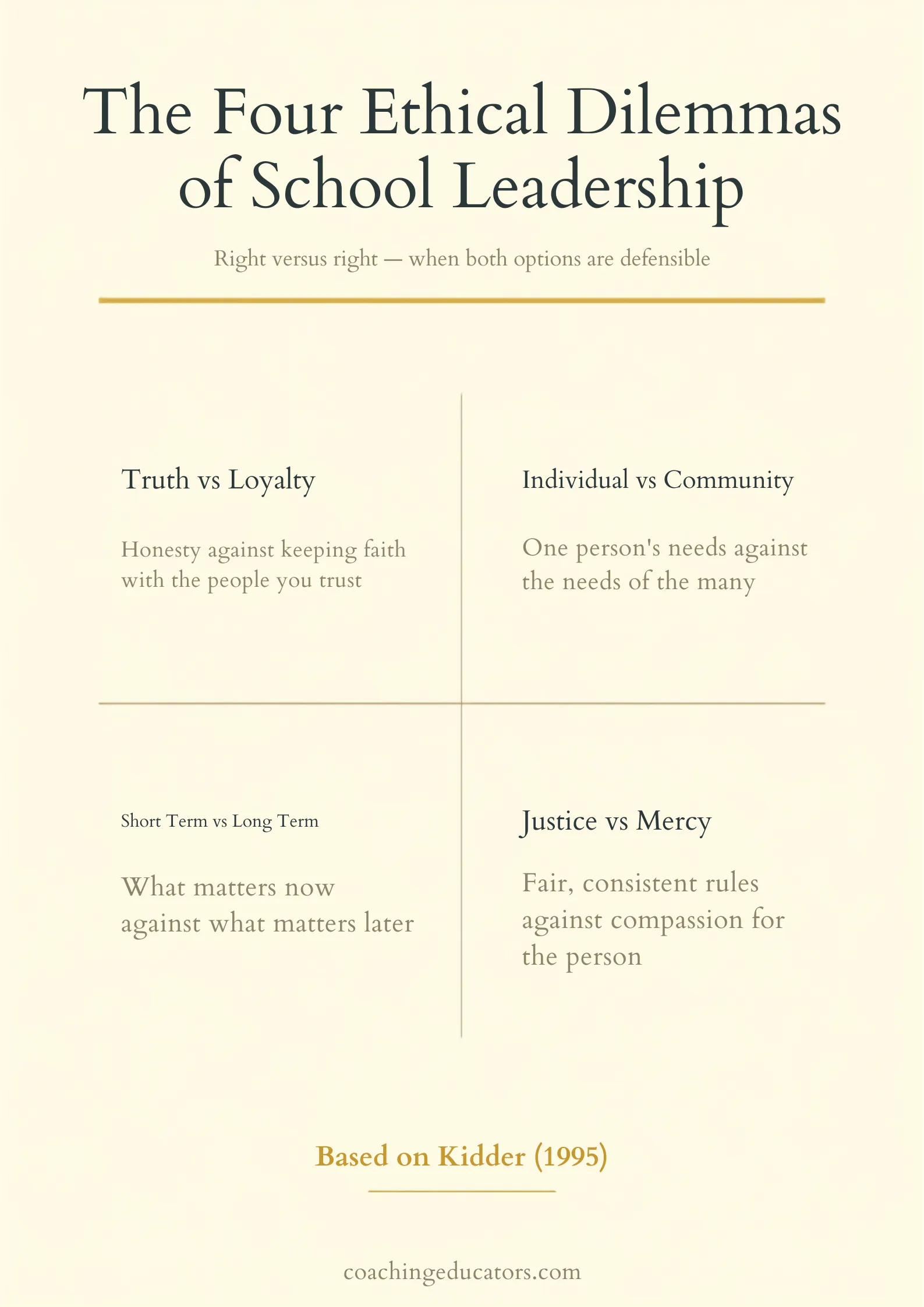
Kidder suggests that these dilemmas, for all their apparent variety, keep arriving in four recognisable patterns, and I’ll be honest, once he pointed them out I couldn’t stop seeing them.
There is **truth against loyalty** — the reference for the colleague you are fond of but would not appoint again; whether you pass upwards something a member of your team told you in confidence.
There is **the individual against the community**, which is where my TA allocation lived, and where exclusions live, and where the extraordinary teacher whose corrosiveness is quietly costing you a team lives too.
There is **the short term against the long term** — the money spent on what parents can see, against the professional development that nobody will notice the effect of for a few years; the safe appointment now, or the risk that builds something.
And there is **justice against mercy** — the behaviour policy applied consistently and fairly, which is the whole point of having one, applied to a child whose home life you know full well about.
None of those is a puzzle waiting for the right person to solve it. Each is a genuine collision between two goods, and I’ve come to think schools are unusually dense in them, because we hold several serious commitments at once and mean all of them. Every child matters, and the community has to function. Both entirely true.
The lens you didn’t know you were using
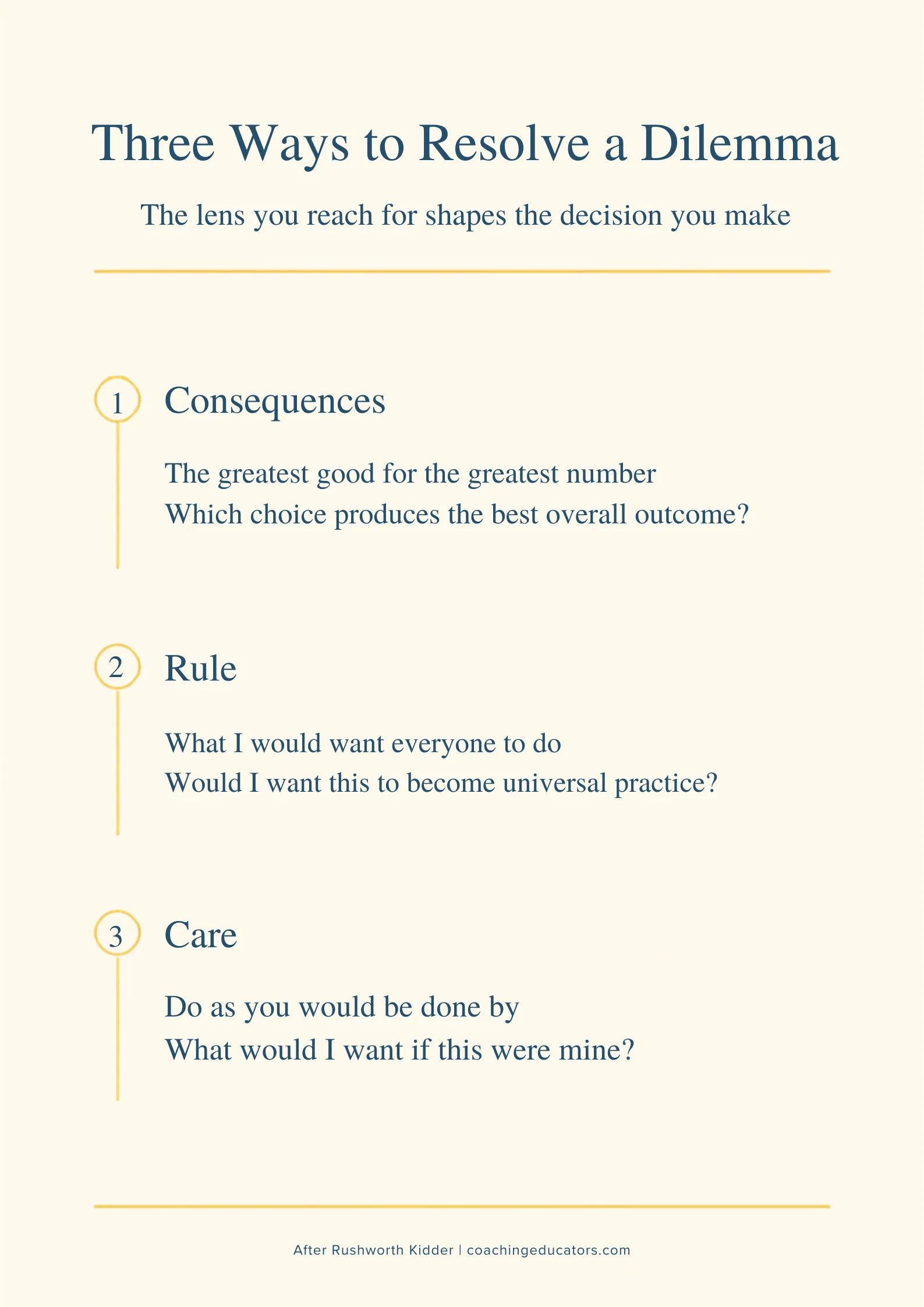
Kidder offers three ways of resolving these things, and what struck me was not that they were new — they are, broadly, the great traditions of moral philosophy in working clothes — but that most of us are already using one of them, habitually, without ever having chosen it.
You can decide by consequences: what produces the greatest good for the greatest number. Twenty-four children, or one.
You can decide by rule: what would I want to become universal practice, if every leader in this trust faced this and decided as I am about to decide?
Or you can decide by care: do as you would be done by. If that child were mine, what would I want? And then, and this is the question that stops you, if one of the 24 were mine, what would I want then?
The three will not always point the same way, which is not a weakness of the framework but an accurate account of why the decision is hard in the first place. What’s genuinely useful here is diagnostic. Under pressure, most of us reach for the same lens every time and mistake the feeling of reaching for it for the feeling of thinking. If you have always been a consequences person, the arithmetic will feel like clarity. It isn’t clarity. It’s a habit. And knowing which one you reach for first, and deliberately making yourself try the other two before you commit, is one of the more useful disciplines I know of.
Where I’d be careful
“It’s a genuine ethical dilemma” is a lovely sentence to say about a decision you are avoiding because it is going to be horrible. The difficult conversation with the underperforming teacher is not usually a dilemma. It’s a temptation, in Kidder’s sense — you know exactly what needs to happen and you would rather it happened next term. So the first question is never which of the four patterns this is. The first question is whether it is a dilemma at all, or whether you are dressing up a temptation as one, and I’d encourage you to be quite ruthless with yourself at that door, because the whole framework is worthless if you aren’t.
The related trap, and I see this one constantly, is the false third way. Kidder allows that sometimes there is a genuine option that transcends the dilemma altogether, and it’s worth two minutes of looking for it. But what happens far more often in schools is that we split the difference — we spread the TA hours so thinly that neither the one nor the 24 are actually served — and we tell ourselves we found a compromise when what we really did was decline to decide, and distribute the cost so evenly that nobody can trace it back to us.
What actually changes
None of this makes the decision easier.
What it changes is your relationship with the decision, in my experience coaching school leaders it is the relationship with the decision that the school leader loses sleep over. In some coaching sessions we unpack decisions to be made using frameworks like this, clients find that this clarity of thinking greatly helps them to lead with clarity and confidence.
Kidder’s phrase for the capacity to do this well is ethical fitness, and I find that a genuinely clarifying way to think about it. Fitness isn’t a state you arrive at. It’s a practice you keep up, and you build it long before the crisis, not during it. Nobody works out what they believe about justice and mercy while a distraught parent is standing in the doorway.
So my suggestion, for what it’s worth, is to do it now, when nothing is on fire. Take one decision from last term that you are still carrying about with you. Give it its name. Work out which of the three lenses you actually used, rather than the one you’d have said you used, and then ask yourself honestly what the other two would have told you.
You may well find that you didn’t get it wrong at all. You may find that you paid a price, knowingly, because both roads had one, and that the weight you’ve been carrying since is not a symptom of poor judgement but simply the cost of a job in which the things you care about will not all fit.
-–
*Rushworth Kidder, How Good People Make Tough Choices: Resolving the Dilemmas of Ethical Living (Harper, revised edition, 2009).*